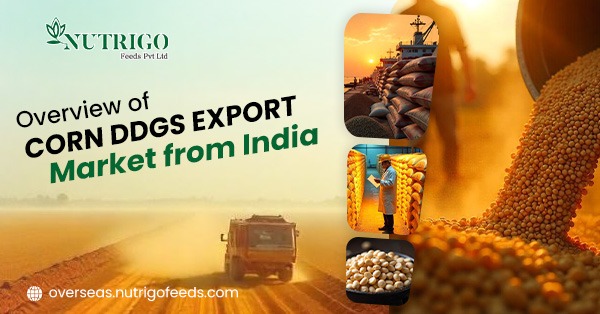
The global feed industry is in a shift to find more cost-effective and nutrient-rich products for animal nutrition. The demand for Corn DDGS exporters from India is rising day by day. The country is known for providing high-quality corn distillers’ dried grains with soluble (DDGS) as a byproduct of ethanol fermentation. The protein content of the corn by-product significantly contributes to reducing the dependency on costly soybean meal for poultry and cattle. Hence, there is an increased demand for corn DDGS from various countries in Southeast Asia and the Middle East.
The demand for corn DDGS is growing, as it is non-GMO, which is an essential criterion for most countries. Additionally, the push for ethanol blending from the Indian government has provided encouragement to the DDGS industry. Today, investors are showing more interest in this sector, & it is now considered to be one of the most promising markets for animal nutrition solutions. Therefore, Corn DDGS exporters from India are witnessing a significant increase in international inquiries this year. The present blog will shed light on the growing demand for corn DDGS from various countries for animal nutrition purposes.
Growing Global Demand for Indian Corn DDGS in Animal Nutrition
The growing global demand for high-protein animal feed has made corn DDGS from India an essential component of the animal nutrition sector. Today, animal nutritionists are in search of ways to cut costs without compromising on animal growth rates.
Corn DDGS from India is an excellent solution for animal nutrition as it contains 26% to 30% protein. This will play an essential role in increasing milk production in dairy animals. The aquaculture sector is also utilizing corn DDGS from India, as it is highly digestible. Today, most corn DDGs exporters from India are planning to upgrade their facilities to meet international quality standards.
- Increasing demand for meat products globally creates a requirement for efficient and cost-effective animal feed.
- Indian corn DDGS offers a 100 percent non-GMO alternative to American and Brazilian corn varieties.
- This offers a mix of amino and fiber content necessary for a healthy growth medium for poultry.
- The E20 ethanol blending mandate in India has also helped in the increased availability of the byproduct.
- Dairy farmers also prefer using DDGS in animal feed, as it helps maintain the desired levels of fat and protein.
- The price advantage over soybean meal also gives Indian suppliers a competitive advantage.
- The use of advanced drying technology also helps in the longer shelf life of the exported feed.
Recent international trade trends indicate that Indian corn DDGS prices range from ₹28,000 to ₹35,000 per metric tonne. This price stability has also helped attract the interest of bulk importers to safeguard against price volatility in the international soybean market. Hence, the importance of corn DDGs exporters from India has become a necessity in the international market.
Key Export Destinations and Trends Influencing the Market
Major Export Destinations
- Vietnam
- Bangladesh
- Sri Lanka
- South Korea
- Thailand
- Indonesia
- Malaysia
- Oman
- Saudi Arabia
Trade Trends Shaping the Market
Surge in Southeast Asian Imports
Currently, Vietnam and Indonesia are the biggest buyers of Indian animal feed products due to the high levels of aqua farming in these countries. These countries also benefit from the shorter distance from the Indian ports compared to the American and Brazilian ports. As a result, corn DDGs exporters from India to Vietnam are experiencing rapid business expansion.
Non-GMO Certification Requirements
Global buyers are increasingly looking for non-GMO certified feed products to adhere to stringent food safety regulations in Europe and Asia. Being a non-GMO corn-producing country is a huge advantage for India. This status gives corn DDGs exporters from India the preferred choice for health-conscious global markets.
Ethanol Policy Synergy
The Indian government’s ethanol blending initiative has created a synergy between the power and agriculture sectors. This policy has ensured that corn DDGs exporters from India have a consistent surplus to supply to the export market.
Logistics and Port Infrastructure
Indian port facilities have improved considerably, reducing turnaround time for exporting bulk grain products substantially. This has enhanced the competitive edge for Indian exports in the Middle Eastern market.
Shift in Protein Sourcing
Feed manufacturers in Vietnam are increasingly adopting DDGS as a replacement for soybean meal to save on 15% of their feed procurement costs. This has resulted in record-high order volume for corn DDGs suppliers from India to Vietnam this year.
Factors Driving the Expansion of Corn DDGS Exports from India
There are several internal and external factors driving the growth of the Indian export industry for DDGS. Firstly, the geographical proximity of India to Asia allows for significant savings on freight costs for DDGS suppliers. For instance, Corn DDGs exporters from India to Vietnam can deliver cargo within 12 to 14 days. This allows for fresh feed to be supplied to customers while still retaining nutritional value. Secondly, the escalating prices of traditional feed ingredients have forced feed manufacturers to innovate their diet formulation recipes.
- Indian ports are offering competitive FOB prices for DDGS suppliers compared to other countries.
- This ensures the availability of fresh stocks of DDGS material throughout the year for export.
- More awareness about the phosphorus content in DDGS material among international nutritionists.
- The rise of dedicated manufacturers who ensure a consistent supply for corn DDGs suppliers from India to Vietnam and other Asian hubs.
- Trade policies with neighboring countries have been favorable, which helps in the smooth clearance of imports with lower duty.
The quality of grains used in Indian distilleries ensures a consistent protein content. This helps in building trust with international brands in the feed sector.
The Bottom Line
The Indian market for corn DDGS is expected to grow exponentially with the rise in demand for animal protein products globally. The advantage of being a non-GMO player in the market helps corn DDGs exporters from India gain a competitive advantage over their counterparts in the West. These exporters are now vital to the global supply chain, as they maintain the highest product quality. Partnering with reliable partners like Nutrigo Feeds ensures that the end customer gets the best quality of the product. With the rise in logistics efficiency in the coming years, the Indian market is poised to dominate the Asian market.
For more information you can send us an email on nutrigofeeds@gmail.com and we’ll get in touch shortly, or Call Us – Tel: +91-7087879990, +91-7087879991.
Frequently Asked Questions
Q.1 What is the protein content in Indian Corn DDGS?
Ans. The Indian variety of corn, DDGS, contains 26–30 percent protein content.
Q.2 Why is Indian DDGS material more popular in Vietnam?
Ans. Indian DDGS is more popular in Vietnam as it is 100 percent non-GMO and is delivered much faster compared to the US.
Q.3 What is the average price of Corn DDGS in India?
Ans. The price in the market usually ranges from ₹28,000 to ₹35,000 per metric tone.
Q.4 Is Corn DDGS safe to use in aquaculture?
Ans. Yes, it is highly digestible and gives the necessary energy to the fish and the shrimp. It is also used in aqua feed in Southeast Asia.
Q.5 What impact will the increase in ethanol manufacturing have on the supply of DDGS?
Ans. With the increase in ethanol manufacturing, the supply of DDGS will also increase, as it is a byproduct. India’s E20 policy has already increased the supply.
Q.6 Who are the main buyers of Indian Corn DDGS?
Ans. The main buyers or importers of Indian feed products are Vietnam, Bangladesh, and Sri Lanka. They import Indian feed products and use them for the poultry and dairy industry.
Q.7 What are the shipping times from India to Vietnam?
Ans. The shipping time from India to Vietnam via ship will take around 10 to 14 days. This is much quicker than the 35-day transit time from Brazil.
Q.8 Does corn DDGS contain any dangerous toxins?
Ans. Quality-conscious exporters will carry out tests to ensure the product is safe and free from any kind of toxin, such as aflatoxin. Drying the product properly will also prevent the growth of mold.
Q.9 Can DDGS replace soybean meal totally?
Ans. DDGS will be used as a partial replacement for soybean meal. It will replace 15 to 25 percent of the total ration.
Q.10 What is the shelf life of the exported DDGS?
Ans. The shelf life of the exported DDGS will be up to six months when stored in a cool and dry place.