Overview:
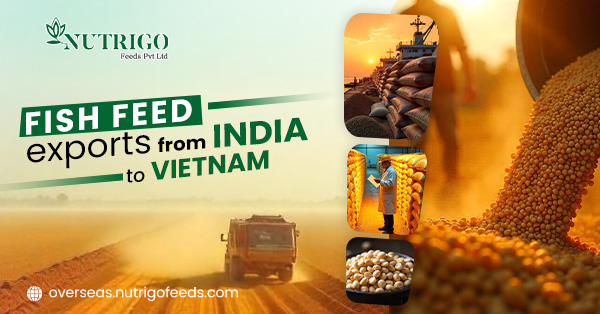
India is now among the fastest-growing fish feed export centres. The reliable fish feed exporter from India to Vietnam has grown significantly in the recent past. Growing seafood demand in Vietnam & advanced aquaculture premises opened immense opportunities for Indian suppliers. Fish feed shipments primarily consist of protein-rich and well-fortified nutrient products that contribute to the rapid growth of fish species.
India produces aquafeed of various types, such as rice-based, maize-based & others with combinations of other proteins. The business has really taken off with government support, as well as private enterprise entering into commercial output. India exported aquaculture products worth over $8.2 billion in 2024, with fish feed being the leading export.
Vietnam remains one of the leading importers due to its booming aquaculture industry and exporting fish both within the country and overseas. Businesses such as Nutrigo Feeds are actually driving the business growth through the supply of special blends according to the nutritional requirements of Vietnamese aquaculture farms.
Expanding Role of Rice DDGS Fish Feed in Global Trade
Rising Popularity: Many people are getting on the Rice DDGS fish feed bandwagon because it’s a more environmentally friendly protein source. And Indian manufacturers are producing at full speed to match what Vietnam is demanding.
Cost-Effective Ingredient: While maintaining the nutrients, rice DDGS reduces feed expenses. That’s why it’s the first choice for fish farms in Vietnam.
Nutritional Advantage: Rice DDGS mixed into fish feed is a great means of providing them with the protein, fibre, and energy needed to grow faster. It is widely utilised in the aquaculture of tilapia and carp.
Market Expansion: Only premium feed is used in Vietnamese fish farms’ exports to the US and Europe. Indian exporters are taking the initiative to investigate this prospect.
Support from suppliers: The top fish feed exporter from India to Vietnam supplies regular raw materials to ensure quality in export consignments. Hence, this lends credibility to products.
Trade-Friendly Policies: India and Vietnam’s free trade agreements have, in fact, increased the level of confidence among feed exporters. Moreover, tariff reduction has given new avenues of growth.
Sustainability Factor: Rice DDGS encourages circular economy activities through the use of by-products to the best extent.
Strengthening the Global Position of Rice DDGS for Aquaculture Feed
World demand for rice DDGS for aquaculture feed has been a healthy business for Indian exporters. As Vietnam is the largest aquaculture producer, its feed demand keeps increasing. India also has the benefit of being able to supply stable volumes at reasonable prices and has a strengthened position. Indian fish feed exports to Vietnam are also targeting niche diets that are appropriate for the needs of certain species.
Thus, Indian aquaculture feed nutrient businesses are investing in research to make feed more digestible & cut waste. Furthermore, that truly adds value to the export chain. And with pressure towards sustainable aquafeed, rice-based products are truly at the forefront in trade. As Vietnam’s aquaculture exports increase in foreign markets, Indian feed suppliers are reliable partners. This sort of collaboration guarantees that there’s nutritional value, it’s affordable & it continues to be sustainable in the entire process.
Demand Trends in Vietnam
Vietnam’s aquaculture industry alone handles more than 6 million tonnes of aquafeed annually. India’s imports also continue to increase due to the increasing production requirements.
The Role of Technology in Exports
Indian exporters are employing extrusion technology and pelletising plants to equip themselves with international standards. Additionally, this improves the supply of fish feed efficiency.
Supply Chain Strength
With improved port facilities and logistics, faster transportation of fish feed to Vietnam is possible. Hence, this improves trade with Vietnam.
Growing Market for India Fish Feed Exporters to Vietnam
India has actually ramped up its fish feed game for Vietnam over the past decade. With more and more people seeking high-quality feed, Indian enterprises are scaling up production and getting creative with what they’ve got. Vietnam is one of the top aquaculture players in Asia. Their need for sustainable fish feed fits nicely with India’s track record of making well-balanced formulations.
On top of that, with prices that won’t hurt the wallet, consistent quality, and strong trade relations, things are definitely on the upswing. Export volumes have been growing by double digits annually, which shows some good growth.
Final Thoughts:
There is a high demand for a reliable fish feed exporter from India to Vietnam due to the rising demand for aquaculture, cost-effectiveness, and environmentally friendly inputs. Greater use of rice DDGS fish feed and reliable aquaculture feed nutrient sources in India makes export highly competitive. Indian providers will be pace-setters in sustaining that growth as Vietnam’s aquaculture market grows.
Nutrigo Feeds is one of the leading aquaculture feed nutrients suppliers in India. They are going to remain ahead of the curve, with consistent quality and products adhering to international standards for customers from across the world.
Frequently Asked Questions:
Q. Why is India becoming a top fish feed exporter from India to Vietnam?
Ans. India has low-cost, nutrient-rich aquafeed with strong logistics and trade networks, and thus is a favourite to export to Vietnam.
Q. How does Rice DDGS fish feed benefit aquaculture farmers in Vietnam?
Ans. It lowers the overall cost of feeding, raises the levels of nutrition & promotes sustainable farming in intensive aquaculture.
Q. What role do aquaculture feed nutrients suppliers in India play in exports?
Ans. They are consistent sources of quality inputs and stable raw materials to bring stability to Vietnamese-exported feed formulations in the Vietnamese market.
Q. Why is Rice DDGS for aquaculture feed in high demand globally?
Ans. It is a renewable protein, promotes more fish growth, and is in agreement with green practices; thus, it is a favourite all over the world.